
%20(Post%20de.png)
Ideas for developing a collaborative culture

Updated: 3 days ago
Define your organization's mission, vision, and values to build a strong strategic plan, guide decision-making, and drive long-term success.

Developing a collaborative organizational culture is essential for creating an environment in which employees feel valued, motivated, involved, and committed to achieving common goals. Collaboration goes beyond simply working together: it involves sharing knowledge, communicating openly, respecting different perspectives, participating in decision-making, and taking collective responsibility for results.
To understand how a collaborative culture can be developed, it is first necessary to understand the relationship between organizational identity, philosophy, and culture.
1. Organizational Identity
The identity of an organization is similar to the personality of an individual. It is inherent to the organization and exists from the moment it is created. This identity is formed by a combination of essential characteristics that define what the organization is, what it believes in, and what makes it different from others.
Organizational identity represents the image that an institution wants to project about itself and how it wants to be recognized by its employees, customers, stakeholders, and society.
It can be analyzed through two closely interconnected components: organizational philosophy and organizational culture. Both influence each other and contribute to establishing a consistent identity.
Organizational Philosophy
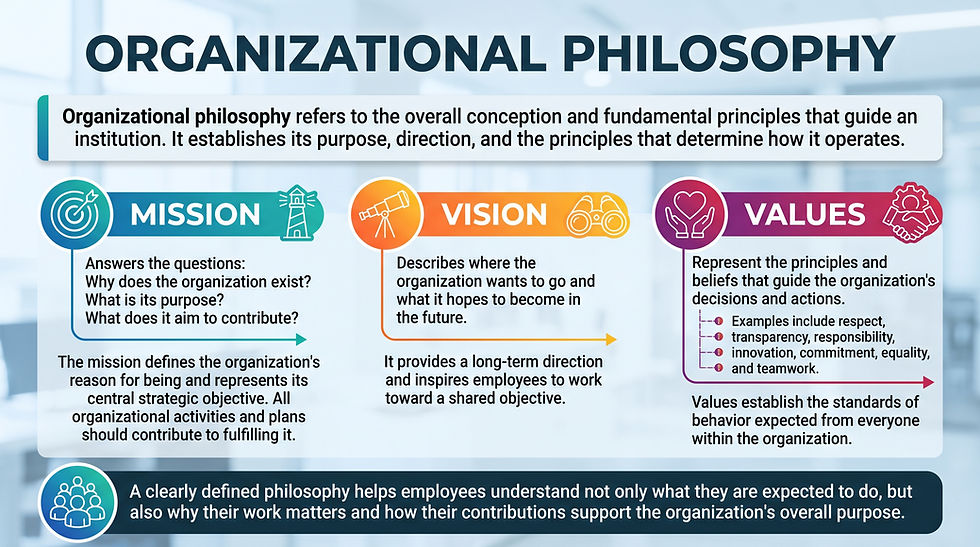
Organizational philosophy refers to the overall conception and fundamental principles that guide an institution. It establishes its purpose, direction, and the principles that determine how it operates.
It consists of three main elements:
- Mission: Answers the questions: Why does the organization exist? What is its purpose? What does it aim to contribute? The mission defines the organization's reason for being and represents its central strategic objective. All organizational activities and plans should contribute to fulfilling it.
- Vision: Describes where the organization wants to go and what it hopes to become in the future. It provides a long-term direction and inspires employees to work toward a shared objective.
- Values: Represent the principles and beliefs that guide the organization's decisions and actions. Examples include respect, transparency, responsibility, innovation, commitment, equality, and teamwork. Values establish the standards of behavior expected from everyone within the organization.
A clearly defined philosophy helps employees understand not only what they are expected to do, but also why their work matters and how their contributions support the organization's overall purpose.
Organizational Culture
Organizational culture consists of the shared norms, values, beliefs, attitudes, and codes of conduct that influence the behavior of the people who belong to an organization.
It is reflected in the way employees communicate, cooperate, solve problems, make decisions, manage conflicts, and relate to one another.
Organizational culture is influenced by several factors, including:
Organizational structure: The distribution of responsibilities, authority, and decision-making power.
Human resources: The people who form the organization, their skills, attitudes, motivations, and relationships.
Organizational history: Past experiences, traditions, achievements, and challenges that shape collective identity.
Social environment: The economic, cultural, political, and social context in which the organization operates.
Leadership style: The way managers guide teams, communicate expectations, encourage participation, and resolve conflicts.
Internal communication: The channels and processes through which information, ideas, and feedback are exchanged.
A positive organizational culture encourages trust, mutual respect, participation, and a sense of belonging. In contrast, a culture based on excessive hierarchy, competition, or poor communication can create barriers to collaboration.

2. Components and Levels of Organizational Culture
Organizational culture can be understood through three fundamental dimensions:
What we are: Refers to the attributes that define the organization's identity and distinguish it from other institutions.
What we think: Refers to the beliefs, principles, and values shared by organizational members, which influence their attitudes and decisions.
What we do: Refers to the behaviors, actions, strategies, and practices through which the organization's identity and values become visible.
These three dimensions must be consistent. For example, an organization that identifies teamwork as one of its core values must establish working practices that encourage cooperation rather than individual competition.
Three Levels of Organizational Culture
Organizational culture manifests itself at three different levels:
1. Explicit behaviors
This is the most visible level of organizational culture. It includes employees' everyday actions, communication styles, dress codes, workplace relationships, organizational rituals, and ways of working.
Because these behaviors are observable, they are generally easier to identify and modify. For example, introducing regular team meetings or collaborative projects can encourage more frequent interaction between employees.
2. Shared values
This level includes the principles and beliefs that guide employees' behavior and influence how they interpret organizational situations.
Values such as trust, respect, accountability, transparency, and solidarity shape workplace relationships. However, changing them requires time, consistency, and commitment from both employees and management.
3. Basic assumptions
These are the deepest and often unconscious beliefs that members of an organization take for granted. They influence how people understand authority, teamwork, responsibility, success, failure, and change.
For example, employees may unconsciously believe that expressing disagreement with a manager is inappropriate or that asking for help demonstrates weakness.
These assumptions are particularly difficult to change because they are deeply rooted in organizational habits and experiences. Transforming them requires sustained leadership, open communication, and changes in everyday organizational practices.
3. Functions of Organizational Culture
Organizational culture performs several important functions:
Building organizational identity: It reinforces the characteristics, beliefs, and values that distinguish an organization from others.
Promoting cohesion: It creates a shared sense of belonging and strengthens relationships between employees.
Encouraging commitment: It helps employees identify with the organization's mission, vision, and objectives.
Guiding behavior: It establishes informal and formal expectations regarding how people should act and interact.
Creating a positive working environment: It influences workplace relationships, motivation, job satisfaction, and employee well-being.
Supporting decision-making: Shared values provide a common framework for evaluating situations and choosing appropriate actions.
Encouraging innovation and adaptability: A culture that values participation and different perspectives makes it easier to generate ideas and respond to change.
Culture therefore acts as an integration mechanism that creates a sense of belonging. Through communication management, organizations must ensure that their culture is aligned with their philosophy. This alignment helps build a coherent organizational identity and encourages employees to work toward common goals.
Importantly, organizational culture should not simply be communicated through slogans or official documents. It must be reflected in leadership decisions, internal policies, working conditions, and everyday behavior.
Culture is an integration factor that creates belonging. That is why, from the communication management we must work to align it with the philosophy, and in this way, achieve an integrated identity oriented to the achievement of the goals and objectives of the organization.

4. Actions to Develop a Collaborative Organizational Culture
A collaborative culture does not emerge automatically. It requires deliberate planning, effective leadership, continuous communication, and the active participation of all organizational members.
The following actions can help organizations develop a more collaborative, inclusive, and participatory working environment.
1. Create a Shared Vision That Includes Everyone
Organizations should develop a vision that reflects the aspirations and contributions of all the people who form part of the institution.
Rather than limiting strategic decisions to senior management, employees should be encouraged to participate in defining organizational priorities and future objectives.
This participation creates a stronger sense of ownership because employees understand that they are not simply following instructions but actively contributing to the organization's development.
As a result, commitment, responsibility, and self-discipline become more important than excessive supervision or hierarchical control.
Practical actions:
Organize participatory workshops to discuss the organization's future.
Encourage employees to propose improvements and new initiatives.
Involve different departments in strategic planning.
Communicate how individual contributions support shared objectives.
2. Define the Organizational Philosophy and Communicate It Effectively
A clear organizational philosophy ensures that everyone understands the institution's purpose, direction, and fundamental principles.
Employees should know what the organization does, why it does it, where it wants to go, and which values should guide its activities.
However, defining the mission, vision, and values is not enough. They must be communicated consistently and incorporated into everyday working practices.
Communication should be clear, accessible, transparent, and adapted to the different groups within the organization.
Practical actions:
Present the mission, vision, and values during employee onboarding.
Include organizational values in internal communication campaigns.
Ensure managers demonstrate these values through their behavior.
Explain how strategic decisions are connected to the organizational philosophy.
Use internal newsletters, digital platforms, and team meetings to reinforce the organization's purpose.
3. Expand Communication Channels and Encourage Employee Participation
Open and effective communication is one of the most important foundations of a collaborative culture.
Organizations should create opportunities for employees to express their opinions, share knowledge, propose ideas, and communicate concerns without fear of negative consequences.
Communication should be multidirectional rather than exclusively top-down. This means information must flow between management and employees, between departments, and among colleagues at the same organizational level.
Practical actions:
Organize regular team meetings and departmental discussions.
Introduce workshops, brainstorming sessions, and collaborative activities.
Create spaces for informal interaction, such as business breakfasts or internal events.
Establish suggestion systems and employee feedback channels.
Use digital collaboration platforms to facilitate communication between teams.
Encourage managers to practice active listening and provide constructive feedback.
These initiatives help reduce communication barriers, prevent misunderstandings, and create an environment where different perspectives are appreciated.
4. Establish a Strategic Plan With Clear and Shared Objectives
A collaborative culture requires a common direction. For this reason, organizations should develop a strategic plan that translates their vision into concrete short-, medium-, and long-term objectives.
These objectives should be realistic, measurable, and motivating. They must also be communicated clearly so that every department and employee understands their responsibilities and how their work contributes to the overall strategy.
It is important to establish shared objectives that require cooperation between different teams rather than encouraging departments to work independently or compete against one another.
Practical actions:
Define clear organizational and departmental goals.
Establish individual responsibilities while maintaining collective accountability.
Use measurable indicators to monitor progress.
Encourage cross-departmental projects.
Review objectives regularly and adapt them when circumstances change.
This approach helps ensure that all organizational members work toward the same purpose while maintaining flexibility and adaptability.
5. Measure and Share Results
Evaluating organizational performance is essential for understanding whether collaborative initiatives are achieving their intended objectives.
Organizations should measure not only financial or productivity-related results but also indicators connected to communication, employee participation, teamwork, and workplace satisfaction.
Sharing achievements with employees reinforces the feeling that success is collective rather than individual.
Similarly, discussing mistakes and difficulties openly allows teams to identify problems, learn from experience, and develop better solutions.
Practical actions:
Share progress reports and organizational achievements.
Recognize both individual contributions and collective accomplishments.
Conduct employee satisfaction and engagement surveys.
Evaluate the effectiveness of teamwork and internal communication.
Organize meetings to discuss lessons learned and areas for improvement.
Encourage a culture in which mistakes are treated as learning opportunities rather than reasons for blame.
Measuring and communicating results strengthens transparency, accountability, motivation, and trust.
6. Promote Trust and Psychological Safety
Collaboration is difficult when employees are afraid of making mistakes, expressing disagreement, or asking questions.
Organizations should therefore create an environment in which people feel safe to communicate openly, contribute ideas, and acknowledge difficulties without fear of humiliation or retaliation.
Trust is built through consistency, respect, honesty, and the fulfillment of commitments.
Practical actions:
Encourage employees to express different opinions respectfully.
Avoid blaming individuals when problems arise; focus on identifying solutions.
Ensure that managers respond constructively to criticism.
Establish clear procedures for managing disagreements.
Promote mutual support and respect between colleagues.
A psychologically safe environment encourages creativity, learning, and innovation because employees feel comfortable participating.
7. Encourage Teamwork and Cross-Departmental Collaboration
Organizations often operate through different departments with specific responsibilities. However, excessive separation between these areas can create communication barriers and prevent knowledge sharing.
A collaborative culture requires employees to understand the importance of working beyond their immediate teams and recognizing how different departments contribute to common objectives.
Practical actions:
Create multidisciplinary teams to work on shared projects.
Organize activities that bring employees from different departments together.
Encourage knowledge-sharing sessions.
Establish mentoring and peer-learning programs.
Develop collaborative problem-solving initiatives.
These practices help break down organizational silos and strengthen relationships across the institution.
8. Recognize Contributions and Promote Shared Responsibility
Recognition is an important motivational tool. Employees are more likely to remain engaged when they feel that their efforts and contributions are appreciated.
However, recognition should not focus exclusively on individual performance. Organizations should also acknowledge cooperation, mutual support, knowledge sharing, and collective achievements.
Practical actions:
Publicly recognize successful team projects.
Celebrate milestones and shared achievements.
Encourage peer-to-peer recognition.
Include collaborative behavior in performance evaluations.
Give employees opportunities to take responsibility for projects and decisions.
This approach reinforces the idea that organizational success depends on collective effort.
9. Develop Leadership That Encourages Collaboration
Managers and leaders play a fundamental role in shaping organizational culture because their behavior influences workplace expectations and relationships.
A collaborative leader does not simply assign tasks and supervise performance. They listen, support employees, encourage participation, delegate responsibilities, and create opportunities for professional development.
Practical actions:
Train managers in communication and conflict resolution.
Encourage participatory decision-making.
Promote leadership based on trust and empowerment.
Provide regular feedback and coaching.
Ensure that leaders act consistently with the organization's values.
Leadership must serve as an example of the collaborative culture the organization wants to establish.
5. How to Evaluate Whether a Collaborative Culture Is Developing
Implementing collaborative initiatives is only the first step. Organizations must also evaluate their effectiveness and determine whether employees are actually experiencing a more participatory working environment.
Some useful indicators include:
Area | Indicators |
Communication | Frequency of information sharing, employee feedback, and communication satisfaction. |
Teamwork | Number of collaborative projects and level of cross-departmental cooperation. |
Participation | Employee involvement in meetings and decision-making processes. |
Trust | Employees' willingness to express opinions and ask for help. |
Engagement | Employee motivation, commitment, and sense of belonging. |
Innovation | Number of ideas proposed and implemented by employees. |
Organizational climate | Satisfaction levels and quality of workplace relationships. |
These indicators can be evaluated through surveys, interviews, performance reports, focus groups, and regular feedback sessions.
The results should be shared with employees and used to identify opportunities for continuous improvement.
6. Conclusion
Developing a collaborative organizational culture requires more than introducing occasional teamwork activities or improving communication channels. It involves creating a shared system of values, beliefs, and behaviors that encourages people to work together, participate in decision-making, and take collective responsibility for organizational success.
The organization's philosophy provides the direction through its mission, vision, and values, while its culture determines how these principles are translated into everyday actions.
For this reason, internal communication plays a strategic role in connecting organizational identity with employee behavior. It must facilitate the exchange of information, encourage participation, promote transparency, and reinforce a sense of belonging.
Ultimately, a collaborative culture is built when employees do not simply work for the same organization, but feel that they are working with one another toward a shared purpose. This requires trust, open communication, inclusive leadership, mutual respect, and continuous learning. When these elements become part of everyday organizational life, collaboration becomes not just an organizational strategy, but a fundamental characteristic of the institution itself.

"None of us is as good as all of us put together."
Ray Kroc
DanielaSánchezSilva©


